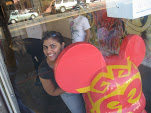
The complaint that brings a patient in often masks something more serious. That was the case with Martha. Martha is a beautiful Ghanian woman. She bears the leather lifelines of 60 years of relentless farming, though they somehow decorate her face nicely. Her dress bestows the essence of Ghanian wear: a headwrap is neatly packaged on top of her head with an ornately, brightly patterned blouse and full-length skirt to match. Underneath this demeanor shines the spirit of a survivor; you see it in her eyes.
Today she comes in complaining of falling twice in the last week. It is hard to imagine a woman with a lifetime practice of balancing her merchandise on her head and walking two miles to simply trip. In fact, that is hardly her case. She describes herself as having “weak knees.” But when you look closer you see a cloudy haze covering those expressive eyes. Like many her age in Central Ghana, she is beginning to have cataracts. Upon asking we find out that she can barely see me sitting right in front of her. For the first time in her life she learns that she is hypertensive with her BP at 160/100. Arthritis, cataracts and hypertension are extremely common problems that plague our elderly, farming population in Ghana. There was no brilliance necessary in realizing that arthritis from 70 years of wear and tear on her knee joint along with her developing cataracts leaves her at risk for one mighty fall and a hip fracture to follow suit.
As horrendous as hip fractures in the elderly in the US may be, we rely on hip replacement surgery, well-trained anesthesiologist to handle the complications of elder age and months of physiotherapy to nurse them back to baseline. If Martha has a fracture, she, with her uncontrolled hypertension, maybe able to get surgery, but she will no longer have an income and become reliant on someone to care for her through months of recovery, hence losing a second income.
This foresight has the head nurse, MaVic, and myself worried for her. We prod her to please, please go to Agogo Hospital’s eye clinic. After all, she has free health insurance from the government (provided for the elderly). Her eyelids sag under the weight of her problems. She can’t afford to miss a day of work, nor can she afford the fare to Agogo Hospital: $ 0.75. The more we tell her go, the heavier her eyes get. She looks away, shortly after she checks out of the conversation.
We play out all the potentially dangerous prospects that lay in her immediate future. “What will you do when you can’t see?” We ask.
“Then I’ll just die,” she says.
Ok, that was not the direction I was hoping the conversation to go. Martha’s eyes are calling for help. But how much hope can you ask a person who has spent a lifetime fighting to put food in her mouth; who has spent a lifetime farming and selling vegetables at the expense of her body?
We find out that she has a daughter who lives nearby. She too will have to take a day off work, she too doesn’t have fare for transportation, but she can take her. Now her eyes dance with uncertainty and a tinge of despair. In this aspect, Martha was more of a guilty mother than anything else; an older mother who strives to be independent of relying on her children. She really doesn’t want to ask for help. Personally, I hate asking for help. So, perhaps only on this level, I understand her angst. However, Martha, MaVic and I talk through it. Martha agrees to ask her.
Certain things in life cross all boundaries; they hit at the core in the most fundamental of human ways. Despair is universal, it is a feeling we all recognize. It is an uncontrollable situation; loss of control. My heart sunk under the weight of her increasingly cloudy eyes. I do not understand why God would bring her into this world under these circumstances and I under my “American” circumstance. Even under these circumstances she came bearing vegetables for the clinic. “Why is it the people with the least amount always want to offer whatever they have and those who have more hold on tighter?” asked MaVic.
There is so much I don’t understand, but this I do: life is much greater than myself and the visible world around me. I am grateful, if only for a brief period in time, to bear witness to that.
Friday, October 30, 2009

Tuesday, October 20, 2009
Looking Beyond the Surface
Half Way There Still is Not Enough.
October, 18, 2009
Sitting down to see patients in whatever community it may be, grants an unparalleled privilege. For this week I have gained access to the inner workings of the villages buried off the main road from Accra to Kumasi in Ghana. One can only see and know so much in week, I cannot claim to know anything more than that.
A few simple reflections: People are the same wherever you go, it is there expectations that change. It seems that poverty in Ghana, Mexico, India and US alike lowers one’s expectations, inversely increasing gratitude to the care received. The gratitude here is immense, for that I am grateful. However, the poverty, limited access, limited resources and lack of education have proven to be far more challenging than the illnesses I see.
Within my first day I learned that Malaria is rampant. There are four different types, we learned in medical school. Falcipurum is the kind you never want to have, it will break down your blood and penetrate your brain. That is the one they have here. My first patient: vomiting and fever. Diagnosis: Malaria. My second patient cough and fever. Diagnosis: Malaria. My third patient: headache and fever. Diagnosis: Malaria. You get the picture.
We sat down with the community health educators this week and learned about the non-scientific science behind the persistent, rampant spread of malaria. For it is not the parasite itself that is as pervasive as the lack of education. “The government provides mosquito nets and mosquito repellent at a small cost. Most of the families have them.” MaVic (the head nurse here) informed me. “They all sit around there homes unused.” I was caught by surprise and it really didn’t make sense at first glance…until we spoke to the community workers:
“Some don’t know how to put it up,” one man said.
“They don’t know what time of day to use it,” a woman added.
“A lot of the nets are old and have holes in them,” a third voice piped up.
“When our kids sit inside the net, they want us to sit with them, but we have to cook dinner. Then what do we do?” a man inquired.
Okay now we’re getting somewhere.
Like the available access to mosquito nets, I was surprised and impressed to learn that the government provides insurance for everyone at low cost. Ah ha, Ghana accomplished in 1989 what we resist, scream and bark about in the US today...
-------------------------------------------------------------------------------------------------
A 24 year old came into see us early this week.
“My stomach and chest hurts,” he explained in Twi. Hawa, one of the nurse’s assistants, translated for me.
So we run the gamut of chest pain, abdominal pain questions English to Twi; Twi to English. This chap sounds very anxious I think and explain to him.
“…and I have pus coming from my penis.” He adds.
Okay. I don’t have computer screen with seven red blinking patients waiting for me in rooms. I can take my time. I take a deep breath. We run the gamut of sexual activity questions.
“I would like to treat him for UTI, Chlamydia and Gonorrhea,” I explain.
“Doctor, we have Doxycylcine and Ciprofloxacin.” Hawa explains.
“Great. What about Ceftriaxone to treat the Gonorrhea?” I ask.
“That we don’t have. He will have to get it from the pharmacy.” Hawa says.
“Ok, will his insurance cover it?” I ask.
“He doesn’t have any.” Hawa informs.
I take a step back. We have a government that insures, mostly subsidized and still we have uninsured patients? The 24 year old male is not the only one. There are many that follow after him. I am once again scratching my head. So I ask the nurse’s assistants to explain:
“They can only go on Fridays after they get paid from the Friday Market.” Says Hawa.
“Even then, they have to take an unpaid day off work and pay for transport to Ejisu (the town thirty minutes away). When they get there they don’t know what to do.” Jan adds.
Our chap came back with the ceftriaxone so we could give the injection. I asked to check him for HIV more out of habit than anything: “where one STD lurks often do many,” we were always taught in Adolescent Fellowship.
“Doctor, his test came back positive. I checked it twice.” Kingsley, the “labman” informed.
My heart sank, as did MaVics. We brought him in to talk to him. MaVic did the talking in Twi. “I have asked him why he is so worried,” MaVic informed. “He says that he completed secondary school, but has no money to go to college or learn a proper trade. His family cannot provide the support he needs.” She said.
She went on to tell him the results of his test. I sat and watched, not understanding what was said. I watched this young 24 year-old man engage in MaVic’s discussion, then I saw him breath rapidly, then I saw him disengage. “He is asking for water. Please fetch him some water.” MaVic Asked.
Our, already, anxious young man’s world just darkened. All we could do was inform him of it, refer him and hope he goes.
I am grateful for MaVic as the her name (Mama Victoria), the position she holds in this clinic and the presence she commands creates the ethereal community Mother many of the patients need. She will be the mother that the 24 year old chap needs right now as we continue to follow him.
I asked MaVic about the stigma attached to HIV in this community.
She informed me that it has improved tremendously with the onset of better and cheaper treatment (much due to Clinton’s Global Initiative). “The men no longer immediately divorce their wives or wives divorce their husbands as they once did,” MaVic informed. “They know that they can still go on to have a full life.”
The cases are so many, every patient that walks in has so much to teach me. This week I go to a nearby town, Agogo, to follow and learn about local disease and treatment in Agogo Hospital. The best part about it: internet access baby!
October, 18, 2009
Sitting down to see patients in whatever community it may be, grants an unparalleled privilege. For this week I have gained access to the inner workings of the villages buried off the main road from Accra to Kumasi in Ghana. One can only see and know so much in week, I cannot claim to know anything more than that.
A few simple reflections: People are the same wherever you go, it is there expectations that change. It seems that poverty in Ghana, Mexico, India and US alike lowers one’s expectations, inversely increasing gratitude to the care received. The gratitude here is immense, for that I am grateful. However, the poverty, limited access, limited resources and lack of education have proven to be far more challenging than the illnesses I see.
Within my first day I learned that Malaria is rampant. There are four different types, we learned in medical school. Falcipurum is the kind you never want to have, it will break down your blood and penetrate your brain. That is the one they have here. My first patient: vomiting and fever. Diagnosis: Malaria. My second patient cough and fever. Diagnosis: Malaria. My third patient: headache and fever. Diagnosis: Malaria. You get the picture.
We sat down with the community health educators this week and learned about the non-scientific science behind the persistent, rampant spread of malaria. For it is not the parasite itself that is as pervasive as the lack of education. “The government provides mosquito nets and mosquito repellent at a small cost. Most of the families have them.” MaVic (the head nurse here) informed me. “They all sit around there homes unused.” I was caught by surprise and it really didn’t make sense at first glance…until we spoke to the community workers:
“Some don’t know how to put it up,” one man said.
“They don’t know what time of day to use it,” a woman added.
“A lot of the nets are old and have holes in them,” a third voice piped up.
“When our kids sit inside the net, they want us to sit with them, but we have to cook dinner. Then what do we do?” a man inquired.
Okay now we’re getting somewhere.
Like the available access to mosquito nets, I was surprised and impressed to learn that the government provides insurance for everyone at low cost. Ah ha, Ghana accomplished in 1989 what we resist, scream and bark about in the US today...
-------------------------------------------------------------------------------------------------
A 24 year old came into see us early this week.
“My stomach and chest hurts,” he explained in Twi. Hawa, one of the nurse’s assistants, translated for me.
So we run the gamut of chest pain, abdominal pain questions English to Twi; Twi to English. This chap sounds very anxious I think and explain to him.
“…and I have pus coming from my penis.” He adds.
Okay. I don’t have computer screen with seven red blinking patients waiting for me in rooms. I can take my time. I take a deep breath. We run the gamut of sexual activity questions.
“I would like to treat him for UTI, Chlamydia and Gonorrhea,” I explain.
“Doctor, we have Doxycylcine and Ciprofloxacin.” Hawa explains.
“Great. What about Ceftriaxone to treat the Gonorrhea?” I ask.
“That we don’t have. He will have to get it from the pharmacy.” Hawa says.
“Ok, will his insurance cover it?” I ask.
“He doesn’t have any.” Hawa informs.
I take a step back. We have a government that insures, mostly subsidized and still we have uninsured patients? The 24 year old male is not the only one. There are many that follow after him. I am once again scratching my head. So I ask the nurse’s assistants to explain:
“They can only go on Fridays after they get paid from the Friday Market.” Says Hawa.
“Even then, they have to take an unpaid day off work and pay for transport to Ejisu (the town thirty minutes away). When they get there they don’t know what to do.” Jan adds.
Our chap came back with the ceftriaxone so we could give the injection. I asked to check him for HIV more out of habit than anything: “where one STD lurks often do many,” we were always taught in Adolescent Fellowship.
“Doctor, his test came back positive. I checked it twice.” Kingsley, the “labman” informed.
My heart sank, as did MaVics. We brought him in to talk to him. MaVic did the talking in Twi. “I have asked him why he is so worried,” MaVic informed. “He says that he completed secondary school, but has no money to go to college or learn a proper trade. His family cannot provide the support he needs.” She said.
She went on to tell him the results of his test. I sat and watched, not understanding what was said. I watched this young 24 year-old man engage in MaVic’s discussion, then I saw him breath rapidly, then I saw him disengage. “He is asking for water. Please fetch him some water.” MaVic Asked.
Our, already, anxious young man’s world just darkened. All we could do was inform him of it, refer him and hope he goes.
I am grateful for MaVic as the her name (Mama Victoria), the position she holds in this clinic and the presence she commands creates the ethereal community Mother many of the patients need. She will be the mother that the 24 year old chap needs right now as we continue to follow him.
I asked MaVic about the stigma attached to HIV in this community.
She informed me that it has improved tremendously with the onset of better and cheaper treatment (much due to Clinton’s Global Initiative). “The men no longer immediately divorce their wives or wives divorce their husbands as they once did,” MaVic informed. “They know that they can still go on to have a full life.”
The cases are so many, every patient that walks in has so much to teach me. This week I go to a nearby town, Agogo, to follow and learn about local disease and treatment in Agogo Hospital. The best part about it: internet access baby!
Saturday, October 10, 2009
Landing on Two Feet In Ghana
Once in a rare while has life presented a moment where I step back and think, “Wow! This is happening to me.” Two days ago I felt that.
I departed Accra (the capital of Ghana) by bus en route to Huttel Clinic. I was told that if I follow the map to the nearby town, Duampompo, it will get me within a 5 minute taxi drive of the clinic. It wasn’t on the map.
Rest assured the bus driver guaranteed he would drop me off there. Who am I to doubt him? I said a long hard prayer to God that morning with a little reminder, “I am in your hands today.”
My bus was quite cozy. I got a seat by the window with the seat next to me open for my excessive things to unravel and breathe for a minute. It was not long before I saw the bus piling up at our next stop. My things reluctantly resumed their condensed positions back in my backpack; my backpack reluctantly resumed its position on my lap. Low and behold, just the largest lady took that open seat next to me. Not only was my spare seat gone, but part of my own seat as well.
“Patience. Flexiblity. Openess. Acceptance.” I repeated to myself.
“Good afternoon,” she told me.
I concurred.
We exchanged a few kind words. I was quick to disclose my journey to this remote location off the typical Accra to Kumasi route.
“You are new here? Welcome to my country!” she proclaimed.
What a sweet woman! She could share as much of my space as she liked. At points our bodies nuzzled into each other; one nudging elbow permissive and relaxing towards the other. I had to, in fact, hold back from leaning on her shoulder and nodding off.
I asked her if she spoke Twi. “Yes, of course!”
She did not hesitate to start teaching me Twi. “Go on, say Medasi (thank you) to the driver when you get off,” she said.
We were 4 hours into the bus drive and I was just finding my comfort zone when the bus halted. I looked around for any identifiers: No city. No town. Just farmland.
I looked up. The driver was looking at me. “This is you,” he said.
I hesitated to depart from my new best friend. I looked at her longingly. “Remember to say Medasi!” she smiled and chuckled.
The driver unloaded my embarrassing, ginormous pile of bags on to the dirt road. Around me gathered three women. They were clucking in Twi and I was staring at them with my eyes crossed and probably the dumbest smile across my face.
So I was dropped in the middle of rural Africa. I stood there thinking: ‘Wow, this is actually happening to me.’ There was only one thing left to say: “Medasi.” Smile. “Medasi.”
One of these kind women read my mind and fetched me a taxi. I, being MonaVarsh and being a Puri, found myself negotiating a cab fair with no leverage, 4 bags, no clue as to where I was nor how far I needed to go. I quickly realized- his price was the right price. We drove about 32 seconds before we pulled to the side and four men piled into the back seat. With a Twi vocabulary of one word, I hugged my backpack tight and sent God a reminder “Medasi for looking out for me today?” Two miles down a bumpy, dirt road we pulled into a pink clinic.
I would be lying if I didn’t say there was an element of shock to what I had enlisted myself for. The clinic is small and basic compared to the luxuries we take for granted at home. However, the love and intent with which it was built was apparent on first glance.
My room is in humble conditions though it has shaped up quite nicely. I will take bucket baths, use an outhouse style toilet and wash my clothes myself. What actually pulled me out of my state of shock are the people with which I live. I look around and see my neighbor, Jan. Not only did she quietly, but dutifully arrange my room and bed for me when I arrived, she cooks and shares her food with me on a daily basis. Jan wakes up daily, preps herself very respectfully and is timely for work. Every time I pass her room I notice that it is maintained in a very tidy fashion. Her sandals are religiously removed prior to stepping into her room. Why, if Jan can live in these standards comfortably, should not I? Especially when realizing that the standards of the clinic rooms are significantly better than the poorer surrounding villagers.
Today I busted out the old school India squat and broom and swept my place clean. I squatted and, probably rather inefficiently, washed our dishes. Before I could huff or puff to myself I looked up to see Jan carrying a bucket of water retrieved from the well on her head for us (she did this three times by the way)!
It is strange how perspective changes so quickly. But my room is cozy now. It is dust free now. It is mosquito, cockroach and bug free! I have my host of books (including a Cecil’s and Nelson’s), a comfy little couch to lay on, space to yoga it up and, of course, Jan as my neighbor.
Jan is one of the four nurses assistants who work at the clinic along with MaVic, the very gracious nurse in charge. I will be speaking Twi before I leave primarily because they won’t be speaking to me if I don’t. These five ladies are just wonderful. They greeted me and continue to receive me with open hearts, generosity and authenticity. They only make me reflect on the kind of world I have been living in that I expect the opposite. A world devoid of contempt, animosity and competition has a calming effect on the soul. Granted I am three days in, we’ll see what 6 weeks down the road has in store for me…
Next up patients, population and providing care in limited resources.
I departed Accra (the capital of Ghana) by bus en route to Huttel Clinic. I was told that if I follow the map to the nearby town, Duampompo, it will get me within a 5 minute taxi drive of the clinic. It wasn’t on the map.
Rest assured the bus driver guaranteed he would drop me off there. Who am I to doubt him? I said a long hard prayer to God that morning with a little reminder, “I am in your hands today.”
My bus was quite cozy. I got a seat by the window with the seat next to me open for my excessive things to unravel and breathe for a minute. It was not long before I saw the bus piling up at our next stop. My things reluctantly resumed their condensed positions back in my backpack; my backpack reluctantly resumed its position on my lap. Low and behold, just the largest lady took that open seat next to me. Not only was my spare seat gone, but part of my own seat as well.
“Patience. Flexiblity. Openess. Acceptance.” I repeated to myself.
“Good afternoon,” she told me.
I concurred.
We exchanged a few kind words. I was quick to disclose my journey to this remote location off the typical Accra to Kumasi route.
“You are new here? Welcome to my country!” she proclaimed.
What a sweet woman! She could share as much of my space as she liked. At points our bodies nuzzled into each other; one nudging elbow permissive and relaxing towards the other. I had to, in fact, hold back from leaning on her shoulder and nodding off.
I asked her if she spoke Twi. “Yes, of course!”
She did not hesitate to start teaching me Twi. “Go on, say Medasi (thank you) to the driver when you get off,” she said.
We were 4 hours into the bus drive and I was just finding my comfort zone when the bus halted. I looked around for any identifiers: No city. No town. Just farmland.
I looked up. The driver was looking at me. “This is you,” he said.
I hesitated to depart from my new best friend. I looked at her longingly. “Remember to say Medasi!” she smiled and chuckled.
The driver unloaded my embarrassing, ginormous pile of bags on to the dirt road. Around me gathered three women. They were clucking in Twi and I was staring at them with my eyes crossed and probably the dumbest smile across my face.
So I was dropped in the middle of rural Africa. I stood there thinking: ‘Wow, this is actually happening to me.’ There was only one thing left to say: “Medasi.” Smile. “Medasi.”
One of these kind women read my mind and fetched me a taxi. I, being MonaVarsh and being a Puri, found myself negotiating a cab fair with no leverage, 4 bags, no clue as to where I was nor how far I needed to go. I quickly realized- his price was the right price. We drove about 32 seconds before we pulled to the side and four men piled into the back seat. With a Twi vocabulary of one word, I hugged my backpack tight and sent God a reminder “Medasi for looking out for me today?” Two miles down a bumpy, dirt road we pulled into a pink clinic.
I would be lying if I didn’t say there was an element of shock to what I had enlisted myself for. The clinic is small and basic compared to the luxuries we take for granted at home. However, the love and intent with which it was built was apparent on first glance.
My room is in humble conditions though it has shaped up quite nicely. I will take bucket baths, use an outhouse style toilet and wash my clothes myself. What actually pulled me out of my state of shock are the people with which I live. I look around and see my neighbor, Jan. Not only did she quietly, but dutifully arrange my room and bed for me when I arrived, she cooks and shares her food with me on a daily basis. Jan wakes up daily, preps herself very respectfully and is timely for work. Every time I pass her room I notice that it is maintained in a very tidy fashion. Her sandals are religiously removed prior to stepping into her room. Why, if Jan can live in these standards comfortably, should not I? Especially when realizing that the standards of the clinic rooms are significantly better than the poorer surrounding villagers.
Today I busted out the old school India squat and broom and swept my place clean. I squatted and, probably rather inefficiently, washed our dishes. Before I could huff or puff to myself I looked up to see Jan carrying a bucket of water retrieved from the well on her head for us (she did this three times by the way)!
It is strange how perspective changes so quickly. But my room is cozy now. It is dust free now. It is mosquito, cockroach and bug free! I have my host of books (including a Cecil’s and Nelson’s), a comfy little couch to lay on, space to yoga it up and, of course, Jan as my neighbor.
Jan is one of the four nurses assistants who work at the clinic along with MaVic, the very gracious nurse in charge. I will be speaking Twi before I leave primarily because they won’t be speaking to me if I don’t. These five ladies are just wonderful. They greeted me and continue to receive me with open hearts, generosity and authenticity. They only make me reflect on the kind of world I have been living in that I expect the opposite. A world devoid of contempt, animosity and competition has a calming effect on the soul. Granted I am three days in, we’ll see what 6 weeks down the road has in store for me…
Next up patients, population and providing care in limited resources.
Tuesday, October 6, 2009
Why Africa?
I had a chance to eat that final delicious Indian meal with the family (in Fremont, of course), prior to taking off. "Why are you going to Africa?" my 16 year old cousin asked.
"To save the starving children," I responded. Just kidding. So on my 24 hour journey, I have been simmering over how I landed up en route to Ghana for 3.5 months.
My first trip to Gujarat, India wet my travel palate. I realized how much I would like to do, how limited my capacity as a premed student was and how tranquil a life away from the bustle of everyday life in the US could be.
I saw the opening for potential travel, unpaid, abroad this year. Afterall, I am not locked into a relationship and do not have children...so seize the opportunity. Monisha is my primary motivator to travel to an African nation: "You can come to India anytime," she said, "but when are you going to have the time and energy to see Africa for an extended period of time."
She (as always :) was right. Little did I know that my younger brother, Munish, would beat me to it and make it out to South Africa this summer. "What is with Africa? Why is everyone going to Africa?" my mom remarked.
She wasn't incorrect, as my brother's girlfriend, Andrea had been out here the summer previous to him. How grateful I am for that as she has made my transition into Ghana a very smooth one: "We have a package for you Miss Puri," I was greeted by the hotel host.
Wow! Who travels to Ghana and has a package waiting for them?
I think I imagined myself just stepping off a plane with a stethoscope draped over my shoulder. "Thank God I am finally a doctor. For sure I will be in high demand!" I would think. As any great adventure, that statement proved to be of utter ignorance and over confidence. Finding a well structured, non-religious, medical project in an African country proved much harder than initially anticipated.
However, I am grateful to have landed with Foundation Human Nature . This organization funds and runs two clinics: one in Ecuador and one in rural Ghana. They picked up this clinic, as it was not being efficiently run before, about 5 years back. They have since educated and trained a lot of the full time staff and created a solid structure to provide health care and education to the surrounding 8000 villagers in the Ashante region of Ghana (about 5 hours north of Accra, the capital).
I have yet to arrive, but I came prepared to sit, to listen, to observe prior to working (much easier said than done for me). I have come prepared to study those foreign diseases we just don't see in the US. Lastly I have come prepared to occupy my time without the benefit of the TV, friends to go out with on a whim and, my greatest addiction, the internet!
I hope to see and learn interesting things and keep you posted as I go every couple of weeks. I so appreciate you reading my blog as it is so meaningful to make this connection with so many out there!
To great adventures, new experiences and meeting new people! Mona-Varsh
Subscribe to:
Comments (Atom)

 Posts
Posts